NordVPN token: what it is, how to get it, and how to use it
A practical guide toNordVPN tokens, including what they’re for, how to generate them, and common use cases.
NordVPN has increasingly supported token-based authentication as a flexible alternative to standard login flows. A token lets you prove your identity to NordVPN services without entering your username and password each time, which can simplify automated setups, router configurations, or temporary access scenarios. This article unpacks what a NordVPN token is, how to generate one, typical use cases, and best practices to keep your account safe.
Comparison of token-based vs. password-based authentication
| Criterion | Token-based authentication | Password-based authentication | Notes |
|---|---|---|---|
| Security focus | Stronger for automation and APIs | Human login focus | varies by setup |
| Primary use case | API access, services without passwords | User login to apps | context-dependent |
| Credential type | Token (short-lived or long-lived) | Password | common contrast |
| Credential rotation | Often automated | Manual user change | policy dependent |
| MFA support | Yes / optional | Yes (MFA) | depends on system |
| Convenience for users | Higher for machines | Higher for humans | trade-offs apply |
Compiled November 2026; check the provider's site for current details.
What a NordVPN token is
- A token is a signed credential issued by your NordVPN account that you can present to NordVPN services to authenticate.
- Tokens can be configured with different lifetimes: temporary (expiring after a set period) or non-expiring (for long-term automation).
- MFA (multi-factor authentication) is commonly recommended when creating tokens to increase security.
Key ideas:
- Tokens reduce the need to expose your primary login credentials in scripts or devices.
- They are especially useful for automated deployments, network devices, or applications that need to connect to NordVPN without a full browser login.
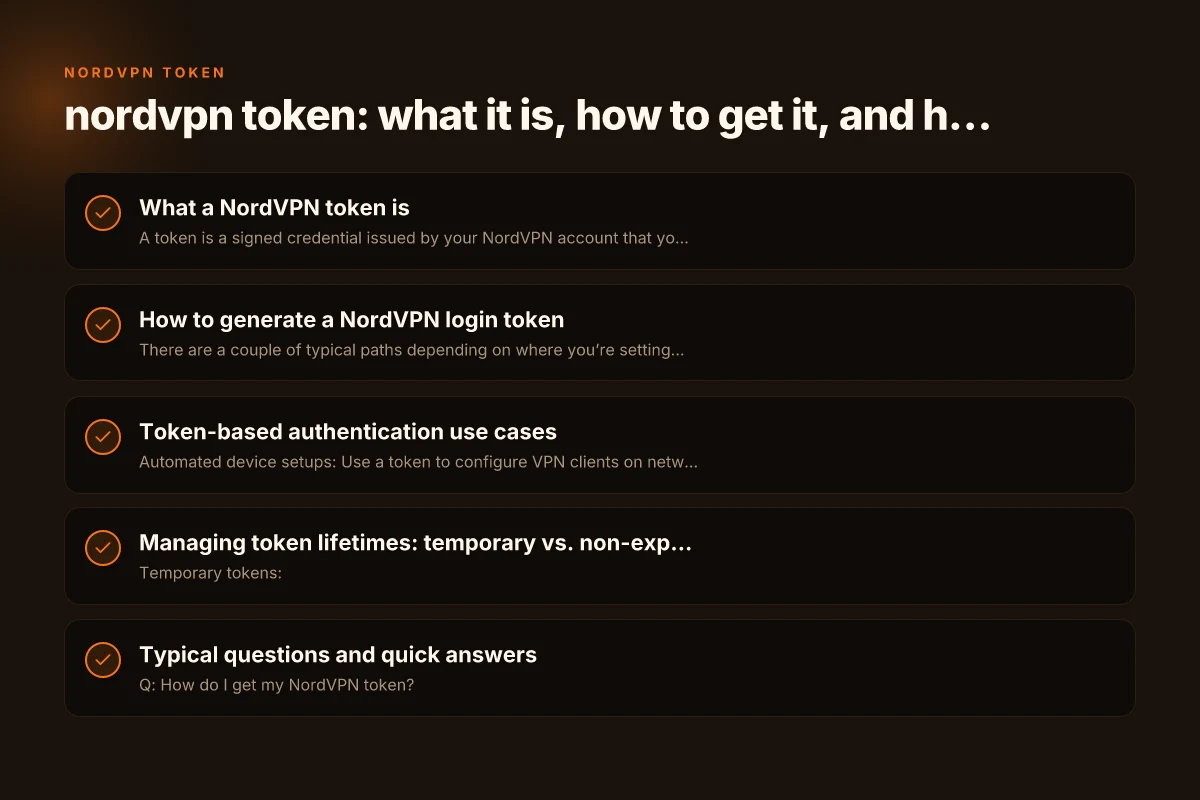
How to generate a NordVPN login token
There are a couple of typical paths depending on where you’re setting things up (browser-based vs. device-based).
- From your Nord account (web):
- Sign in to your Nord Account (the primary account portal).
- Navigate to the NordVPN section or dashboard where access controls or tokens are managed.
- Look for an option labeled “Get access token,” “Create token,” or similar under advanced or security settings.
- Choose token type: temporary (expires in 30 days) or non-expiring.
- If available, enable MFA to add an extra layer of protection.
- Copy the token securely. Store it in a password manager or a secure vault. Do not share the token publicly or commit it in code.
- For router or device integration:
- After generating the token, you’ll typically copy it to the device’s VPN configuration interface or a management console that accepts “Access Token” credentials.
- Some browsers-based steps mention a direct link like /dashboard/nordvpn or similar. Follow the prompts to complete the identity verification (e.g., a code sent to your registered email).
Important notes:
- Tokens may require you to sign in first with your NordVPN credentials.
- Temporary tokens expire after a predefined period (often 30 days). Non-expiring tokens stay valid until they’re revoked.
- If you lose a token or suspect it’s exposed, revoke it immediately and generate a new one.
Token-based authentication use cases
- Automated device setups: Use a token to configure VPN clients on network devices (routers, NAS, or compatible gateways) without interactive login.
- Infrastructure-as-Code (IaC): Integrate token credentials into scripts or deployment pipelines to establish VPN connections during provisioning.
- Temporary access: Provide contractors or guests with a limited, auditable access window without sharing your main login.
- Remote management: Use tokens for remote management apps that need NordVPN access without storing full credentials.
Practical tips for NordVPN token usage
| Tip category | Action item | Expected outcome | Caveats | Recommended practices | Ready-to-implement steps |
|---|---|---|---|---|---|
| Token creation | Generate with official portal | Obtain usable token | keep secret | use least privilege | 1) login 2) create token 3) copy token |
| Storage | Use secure vault | Protects token | avoid plain text | rotate secrets | 1) pick vault 2) store token 3) set access controls |
| Usage scope | Limit to required services | Minimizes exposure | over-permission risks | scope-limited tokens | 1) define scope 2) apply to token |
| Renewal | Track expiry | Prevent auth failures | downtime risk | automate renewal | 1) set reminders 2) auto-renew if supported |
| Revocation | Revoke if compromised | Stop unauthorized access | revocation latency | immediate revoke | 1) revoke 2) audit logs |
| Logging | Enable token usage logs | Detect anomalies | log retention | monitor regularly | 1) enable logs 2) review periodically |
Compiled November 2026; check the provider's site for current details. NordVPN auto connect: how it works, setup tips, and best practices
Managing token lifetimes: temporary vs. non-expiring
- Temporary tokens:
- Pros: Reduced risk of long-term credential exposure. Easier rotation.
- Cons: Requires renewal or recreation when expired. May interrupt automated processes if not planned.
- Non-expiring tokens:
- Pros: Convenience for long-running automation or devices that don’t support interactive login.
- Cons: Higher risk if token is exposed. Requires careful storage, access control, and revocation processes.
Security practices:
- Treat tokens like passwords: keep them in a secure vault, not in plain text files or code repositories.
- Use the principle of least privilege: tokens should grant only the access needed for the task (e.g., read-only vs. full VPN control, if such granularity exists).
- Enable MFA when the option is available during token creation.
- Regularly audit tokens: rotate or revoke unused tokens, and monitor where tokens are used.
Typical questions and quick answers
- Q: How do I get my NordVPN token?
- A: Sign in to your Nord Account, go to the token management area (often labeled “Get access token” or “Create token”), choose the type (temporary or non-expiring), enable MFA if requested, and copy the token securely.
- Q: Can the FBI track NordVPN tokens?
- A: This is a broader privacy and security question. NordVPN tokens, as with any credential, should be protected as a secret. The ability of any party to obtain data depends on multiple factors, including device security, data retention, and applicable laws. Always use recommended security practices and keep tokens secure.
- Q: Where can I find an access token?
- A: In your Nord account dashboard under the NordVPN or security settings. Some guides reference a URL like a dashboard path (e.g., my.nordaccount.com or a subpage). If you don’t see the option, ensure your account has the necessary permissions or contact support.
- Q: What’s the difference between a token and a password?
- A: A token is a credential issued for a specific purpose and can be scoped to limited use with defined lifetimes. A password is a general credential for human login. Tokens reduce exposure of your main login and can be rotated more safely.
A quick comparison: token-based vs. password-based authentication
| Aspect | Token-based authentication | Password-based authentication |
|---|---|---|
| Primary use | Automated, device, or API-style access | Human login and interactive sessions |
| Lifetime | Temporary or non-expiring tokens | Password typically remains the same until changed |
| Rotation | Tokens can be rotated/revoked easily | Password changes can be disruptive and require updates across systems |
| Security risk | If stolen, access is limited to token scope and expiry; MFA reduces risk | Username/password exposure can grant full access if compromised |
| Best practice | Use tokens with least privilege, MFA, and secure storage | Use strong, unique passwords; enable MFA where available |
Practical tips for NordVPN token usage
- Always store tokens in a secure secret manager or vault. Do not hard-code them into binaries or share in public repositories.
- Use environment-specific tokens if you manage multiple environments (dev, staging, prod) to reduce cross-environment risk.
- Monitor token usage where possible: keep an audit log of where and when a token is used.
- Schedule token rotation: for temporary tokens, mark renewal dates in your project plan. For non-expiring tokens, set a periodic security review and revoke unused tokens.
- If you’re integrating with a router or NAS, verify the device firmware supports token-based login and follow the vendor’s recommended steps to apply the token securely.
Final recommendation
If your goal is automation or device provisioning, a NordVPN token is a practical, secure option when used correctly. Start with a temporary token to test your setup, then switch to a non-expiring token only if your security controls (MFA, secure storage, monitoring) are robust. Always revoke tokens you no longer need and implement a rotation plan. For most users, tokens strike a balance between convenience and security, but they require disciplined handling and clear governance to prevent leakage or abuse.
If you’re unsure about any step, consult NordVPN’s official support articles or reach out to their support team. They provide guidance on token creation, management, and best practices tailored to your account and setup.
| VPN | From / month | Plan | Free plan | Refund | Alipay | UnionPay | Crypto | Website opens in China | Trustpilot | |
|---|---|---|---|---|---|---|---|---|---|---|
 NordVPN | $3.49/mo | 27 months: $94.23 | No | 30 days | ? | ✗ | ✓ | ✓ | ✗ Blocked | 4.2/5 (51,628 reviews) |
 ZoogVPN | $2.49/mo | 27 months: $59.99 | Yes | 7 days | ✓ | ✓ | ✓ | ✓ | ✓ Yes (2.5 s) | 4.2/5 (195 reviews) |
 ExpressVPN | $3.00/mo | 28 months: $84 | No | 30 days | ✗ | ✗ | ✓ | ✗ | ✗ Blocked | 4.4/5 (29,706 reviews) |
 Surfshark | See site | See site | No | 30 days | ✗ | ✗ | ✗ | ✓ | ✗ Blocked | 4.3/5 (31,823 reviews) |
 Proton VPN | $2.99/mo | 12 months: $35.88 | Yes | 30 days | ✗ | ✗ | ✗ | ✓ | ✓ Yes (2.5 s) | 2.1/5 (1,040 reviews) |
 Astrill VPN | $12.50/mo | 24 months: $300 | No | See site | ✗ | ✗ | ✗ | ✓ | ✗ Blocked | 1.3/5 (110 reviews) |
 Private Internet Access | $2.03/mo | 40 months: $81.2 | No | 30 days | ✗ | ✗ | ✗ | ✗ | ✗ Blocked | 4.2/5 (11,033 reviews) |
 CyberGhost | $2.19/mo | 28 months: $61.32 | No | 45 days | ✗ | ✗ | ✗ | ✓ | ✗ Blocked | 4.0/5 (24,178 reviews) |
 PureVPN | $1.69/mo | 60 months: $101.55 | No | 31 days | ? | ✗ | ✗ | ✓ | ✓ Yes (2.6 s) | 4.4/5 (17,994 reviews) |
 AdGuard VPN | $2.99/mo | 24 months: $71.76 | Yes | 30 days | ✓ | ✗ | ✓ | ✓ | Official site blocked; our special link opens (2.3 s) | 4.3/5 (290 reviews) |
 Mullvad | $5.61/mo | €5/mo | No | 14 days | ✗ | ✗ | ✗ | ✓ | ✗ Blocked | 3.2/5 (192 reviews) |
 Windscribe | $5.75/mo | 12 months: $69 | Yes | See site | ✗ | ✗ | ✗ | ✓ | ✗ Blocked | 4.7/5 (13,355 reviews) |
 StrongVPN | See site | See site | No | 30 days | ✓ | ✗ | ✗ | ✗ | ✗ Blocked | 4.4/5 (2,695 reviews) |
 LightXtreme 闪连 | $7.08/mo | 12 months: $84.99 | Yes | 30 days | ✓ | ✓ | ✓ | ✓ | ✓ Yes (2.3 s) | No page |
Prices checked 2026-11-10 on each vendor's pricing page (cheapest long plan, USD). Check the vendor's checkout for the final price.
Payment methods checked 2026-11-10 on each vendor's payment pages: all 14 take cards and PayPal; ✗ = not listed, ? = the vendor's own pages disagree.
China access: whether the official website opens from mainland China networks (tests the website only, not the VPN connection). Last checked 2026-11-11 04:07 Beijing time.
Trustpilot score and review count checked 2026-11-10.