NordVPN authenticator app
A complete guide to using the nordvpn authenticator app for MFA, setup, recovery, and troubleshooting.
Opening NordVPN offers two-factor authentication (2FA) to protect your account, and many users choose to connect their NordVPN account with an authenticator app. This article walks through what the NordVPN authenticator app is, how to set it up, what to do if you lose access, common issues, and how it compares to other MFA options. The guidance here is based on NordVPN’s official support articles and common user questions.
Comparison of MFA methods supported by NordVPN
| Method | Requires NordVPN account | Time to set up | Primary use | Security level | Notes |
|---|---|---|---|---|---|
| NordVPN authenticator app (built-in) | yes | quick | login | high | native MFA option |
| TOTP authenticator app (Google Authenticator, Authy, etc.) | yes | quick | login | high | compatible with NordVPN |
| SMS-based codes | yes | slow | login | medium | less secure, not always available |
| Hardware security key (FIDO2) | yes | moderate | login | very high | modern key support |
| Email-based codes | yes | slow | login | medium | not recommended for security |
| Push notification (if supported) | yes | quick | login | high | depends on app + device |
Compiled November 2026; check the provider's site for current details.
What is the NordVPN authenticator app and MFA
Understanding MFA in NordVPN
- MFA (multi-factor authentication) requires more than just your password to sign in.
- The NordVPN MFA setup commonly uses an authenticator app to generate time-based one-time codes (TOTP).
- Popular authenticator apps include Google Authenticator, Microsoft Authenticator, and Authy, among others.
How the authenticator app works with NordVPN
- You enable MFA in your NordVPN account under the Security or MFA section.
- The authenticator app generates a rolling six- to eight-digit code every 30 seconds (TOTP).
- During sign-in, after entering your password, you’re prompted for the code from your authenticator app.
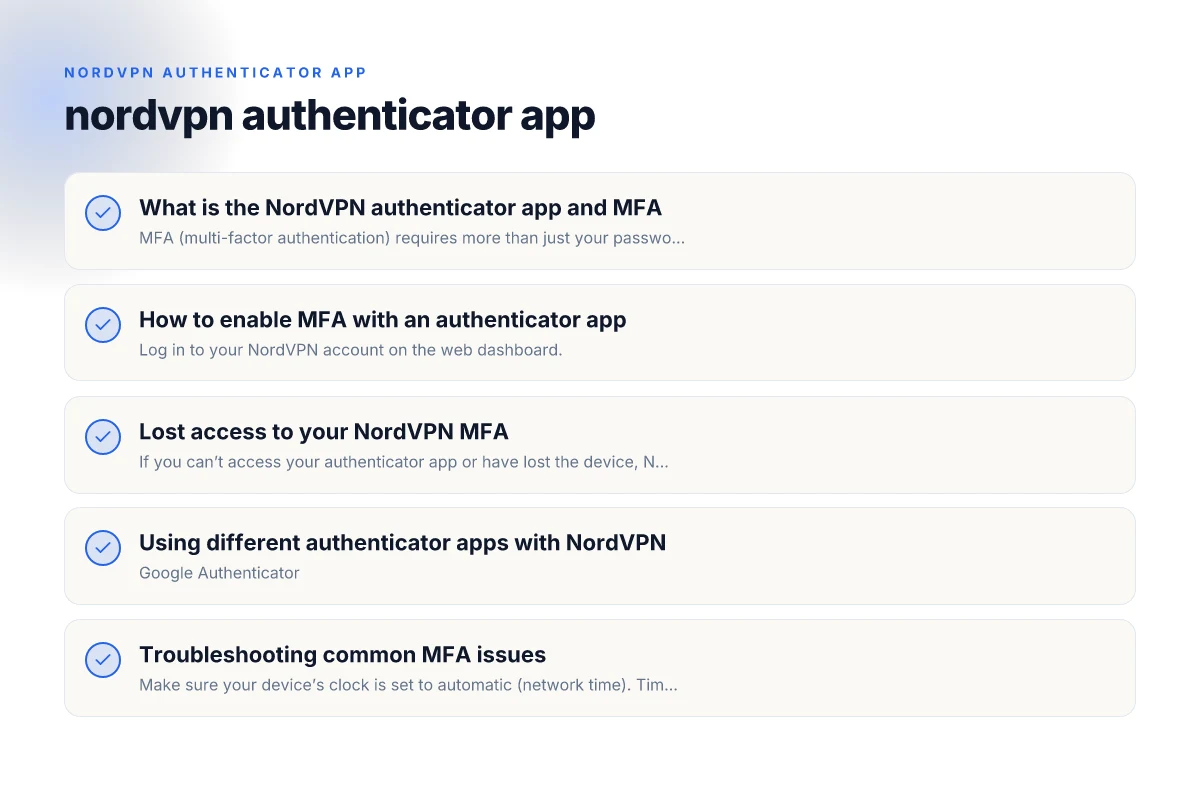
How to enable MFA with an authenticator app
Step-by-step setup
- Log in to your NordVPN account on the web dashboard.
- Open the “Multi-factor authentication (MFA)” tab.
- Choose the option to enable MFA with an authenticator app.
- A QR code will appear on screen (or you may receive a manual code).
- Open your preferred authenticator app (Google, Microsoft, Authy, etc.).
- Use the app to scan the QR code or enter the setup key manually.
- The app will start generating codes. Enter the current code in NordVPN to confirm.
- Save backup codes if NordVPN provides them, and store them securely.
- Complete the setup and test sign-in to verify the code works.
What to expect after setup
- You’ll be prompted for a code at sign-in in addition to your password.
- If you use multiple devices, you can set up MFA on each device’s login flow as needed.
- Some clients allow you to remember a device for 30 days, reducing the number of prompts on trusted devices.
Steps and requirements to enable MFA with an authenticator app
| Step | Action | Prerequisites | Time estimate | Outcome | Notes |
|---|---|---|---|---|---|
| 1 | Sign in to NordVPN account | Active subscription | few minutes | Access to security settings | Use web portal |
| 2 | Navigate to MFA settings | Enabled account access | 1-2 minutes | MFA option visible | Look for "Two-factor" or "Authenticator" |
| 3 | Choose authenticator app | App installed | 1 minute | Selection confirmed | Choose TOTP option if available |
| 4 | Scan QR code with app | Phone with authenticator app | 1 minute | Code generator created | Save backup codes if offered |
| 5 | Enter first 6-digit code | Phone app | 30 seconds | MFA linked | Verify with code |
| 6 | Save backup options | Backup codes / recovery methods | 1 minute | Recovery ready | Store securely |
Compiled November 2026; check the provider's site for current details.
Lost access to your NordVPN MFA
I lost my NordVPN MFA access
If you can’t access your authenticator app or have lost the device, NordVPN provides a way to disable MFA so you can regain access:
- Go to the “Multi-factor authentication (MFA)” tab in your account settings.
- Click the “Disable” button next to the “Authenticator app” section.
- Confirm by clicking “Yes, disable MFA.”
- You’ll regain access to your account without the authenticator code.
- After regaining access, you can re-enable MFA with a new authenticator app on your device.
Important considerations
- Disabling MFA temporarily restores access but weakens security. Re-enable MFA as soon as possible.
- If you’ve changed devices, you can reconfigure MFA by re-enabling it and scanning a new QR code from the NordVPN dashboard.
What if you still can’t sign in?
- If you’re unable to disable MFA because you can’t access the MFA tab, contact NordVPN support with identifying information related to your account.
- They may verify your identity and help reset MFA, or guide you through recovery steps.
Using different authenticator apps with NordVPN
Compatible apps
- Google Authenticator
- Microsoft Authenticator
- Authy
- Any TOTP-based authenticator that supports QR code scanning or manual setup
How to choose an authenticator app
- For device synchronization: Authy can sync across multiple devices, which some users prefer for redundancy.
- For simplicity: Google Authenticator is straightforward and widely supported.
- For backups: Authy offers cloud backup, which can be convenient but may have different security considerations.
Common questions
- Q: What Authenticator app does NordVPN use? A: NordVPN supports standard TOTP-based authenticator apps. You can use Google Authenticator, Microsoft Authenticator, Authy, or any compatible app.
- Q: How to get NordVPN on Authenticator app? A: In NordVPN’s MFA setup, you’ll see a QR code. Scan with your chosen authenticator app to link it to your account.
- Q: How to fix NordVPN authentication error? A: If you receive an invalid code or error, ensure your device’s time is synchronized, the app is up to date, and you’re entering the current code. If issues persist, re-scan the QR code or reconfigure MFA from the security settings.
Troubleshooting common MFA issues
Time synchronization
- Make sure your device’s clock is set to automatic (network time). Time drift can cause codes to be rejected.
- If you’re in a region with clock drift concerns, consider using an authenticator app with backup options or re-scan the QR code to re-sync codes.
QR code vs. manual entry
- If the QR code won’t scan, you can switch to manual setup and enter the provided secret key into your authenticator app.
- Be careful to copy the key exactly as shown, including all characters and dashes if present.
App-specific quirks
- Some apps require a specific format for codes. Ensure you’re entering the code corresponding to the current 30-second window.
- In Authy, if you use cloud backup, ensure the backup is not corrupted and that you’re selecting the correct account when restoring.
Re-enabling MFA after a reset
- After disabling MFA to recover access, re-enable MFA with a fresh QR code to refresh codes and ensure continued security.
- Update backup codes or recovery options if NordVPN provides them.
NordVPN MFA vs. other 2FA factors
| 2FA factor | Pros | Cons | When to use |
|---|---|---|---|
| Authenticator app (TOTP) | Works offline, no network required; codes rotate every 30 seconds; widely supported | You must access the app on a device; device loss can block access if not backed up | Primary MFA method for most users needing strong security with flexibility |
| SMS-based codes | Simple setup; no app required | Less secure; SIM swap risk; mobile signal issues | Quick fallback when app-based MFA is unavailable (not recommended as primary) |
| Hardware security keys (FIDO2) | Strongest security; phishing-resistant | Requires hardware; can be less convenient | High-security environments and users who want maximum protection |
| Email-based codes | Easy to set up; familiar | Email account compromise risk; slower if mail access is restricted | Very low-risk accounts or support-only flows |
Troubleshooting common MFA issues with NordVPN
| Issue | Symptom | Quick fix | Longer fix | Notes | When to contact support |
|---|---|---|---|---|---|
| Code not accepted | Wrong code | Refresh time window, resync | Reconfigure MFA | Time skew possible | If persists > 15 min |
| Authenticator app not syncing | New phone or app update | Re-scan QR code | Relink MFA | Ensure correct account | If QR fail, reset MFA |
| Lost access to authenticator | No codes, no device | Use backup codes | Disable MFA and re-enable | Backup codes needed | Contact support if no codes |
| App not generating codes | App issue | Reinstall app | Use another authenticator | Ensure TOTP selected | Update app |
| SMS codes not arriving | No SMS | Check phone service | Use authenticator app | SMS not reliable | Consider switching to app-based MFA |
| Account locked due to attempts | Multiple failed codes | Wait or unlock via support | Reset MFA settings | Security lockout | Reach out to support |
Compiled November 2026; check the provider's site for current details. NordVPN antivirus: what it is, how it works, and should you use it
Best practices for NordVPN authenticator setup
- Use a trusted authenticator app from a known provider (Google, Microsoft, Authy, etc.).
- Back up your codes or enable app cloud backup if your app supports it (and ensure your backup account is secure).
- Label accounts clearly in your authenticator app so you can distinguish NordVPN from other services.
- Keep your devices secure: enable device passcodes, biometrics where available, and keep OS updates current.
- Consider adding a secondary recovery method if NordVPN offers one (backup codes, recovery email, or trusted devices).
What to do after you enable MFA
- Sign out of all sessions and test a fresh sign-in to ensure MFA works as expected.
- If you use multiple devices (laptops, phones, tablets), configure MFA on each device as needed.
- Document your authenticator app setup in a secure location, including any backup methods NordVPN may provide.
- Review your account’s security settings periodically to ensure nothing has changed unexpectedly.
The recommendation
For most NordVPN users, enabling MFA via an authenticator app provides a strong balance of security and usability. It’s widely supported, works offline, and doesn’t rely on network availability for code generation. If you ever lose access to your authenticator app, NordVPN’s guides explain, step by step, how to disable MFA temporarily to recover access, then re-enable MFA with a fresh setup. If you value redundancy, consider an authenticator app that supports cloud backup (like Authy) while ensuring you protect that backup with a separate password or biometric authentication. Finally, if you encounter persistent login errors, follow NordVPN’s official troubleshooting steps or reach out to support with the details of your issue. Most MFA-related problems are resolvable with reconfiguration or reset.