How to get NordVPN token
A practical guide to obtaining a NordVPN access/login token for account, router, or API use.
NordVPN tokens are a way to authorize devices and applications to connect to your VPN without repeatedly typing credentials. This guide walks you through how to obtain and use a NordVPN login/access token for different scenarios, including logging in without a GUI, use with routers, and via Nord Account settings. Note that the exact path can vary slightly depending on your account type and the NordVPN interface, but the general process remains consistent: log in to your Nord Account, navigate to the appropriate section, and generate a token. Below are the common paths you’re most likely to encounter.
NordVPN token concepts and uses
| Concept | Token type | Primary use | Example scenario |
|---|---|---|---|
| Login token | User token | Authenticate to NordVPN services | Access VPN from app or CLI |
| Router token | Device token | Configure router-based VPN | Router setup without GUI |
| Token-based login | Authentication method | Sign in without GUI | Headless server login |
| Token lifecycle | Management aspect | Expiration, renewal, revocation | Maintain security over time |
| Security level | Protection | End-to-end, storage, exposure risk | Guard against token leakage |
| Supported platforms | Compatibility | Apps and devices that accept tokens | Windows, macOS, Linux, routers |
Compiled November 2026; check the provider's site for current details.
Understanding what a NordVPN token is
- Tokens are access credentials issued by NordVPN’s authentication servers.
- They allow devices or applications to authenticate without re-entering a username/password.
- Tokens typically have an expiration or can be revoked from your Nord Account.
Why you might want a token
- Use with routers or network devices that support token-based authentication.
- Automation scenarios where a script or app needs VPN access without interactive login.
- Managing access for multiple devices without sharing your main credentials.
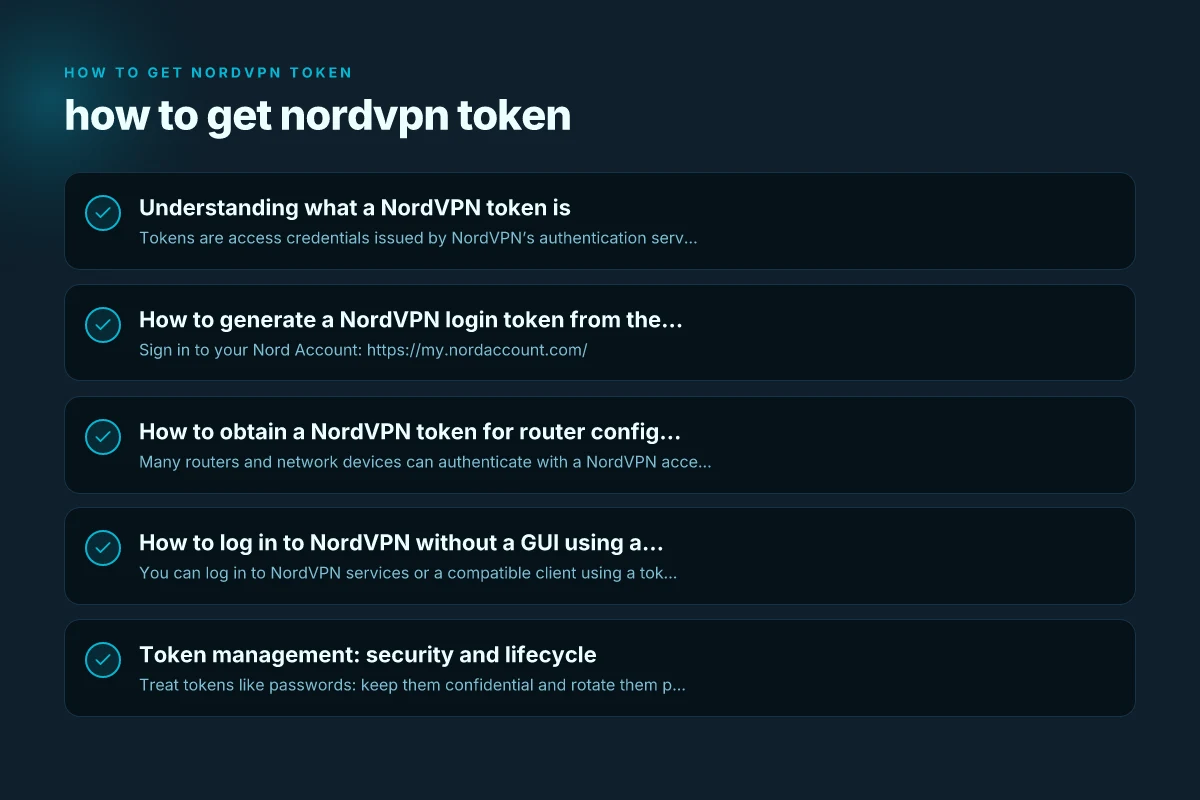
How to generate a NordVPN login token from the Nord Account
- Sign in to your Nord Account: https://my.nordaccount.com/
- In the left-hand navigation, look for a section related to NordVPN or Advanced settings.
- Locate the option to Get access token or Generate new token.
- Click Generate new token and copy the token securely. Store it in a password manager or a secure vault.
- If the option is not visible, ensure your subscription includes NordVPN features and that you are logged in with an account that has admin rights for token generation.
Notes and tips
- Tokens may be labeled as access tokens or login tokens in different interfaces.
- Some interfaces place token options under “NordVPN” > “Advanced settings” > “Get access token.”
- Tokens may come with an expiration date. Check for refresh or re-generation if needed.
How to obtain a NordVPN token for router configuration
- Many routers and network devices can authenticate with a NordVPN access token.
- Steps generally involve generating the token in your Nord Account and then entering it into the router’s VPN settings panel.
- You may also see terms like “manual setup” or “Get access token” when configuring NordVPN on devices.
Typical router setup flow
- Log in to Nord Account.
- Navigate to NordVPN settings or Advanced settings.
- Generate a new access token.
- Copy the token and paste it into the router’s VPN configuration screen (often under VPN > OpenVPN or WireGuard sections, depending on protocol).
- Save and test the connection.
Workflow and options for obtaining tokens
| Step | Method | Required credential | Typical outcome | Risks | Notes |
|---|---|---|---|---|---|
| Generate from Nord Account | Web portal | Nord username/password | Token created | Password exposure risk | Use MFA if available |
| Generate for router | Nord Account or admin panel | Nord credentials; router details | Router token | Misconfig risk | Ensure router supports tokens |
| Token refresh | Renewal process | Current token | New token | Shortened validity window | Set automatic renewal if possible |
| Token revocation | Manual revoke | Access to account | Token invalidated | Access blocked if leaked | Revoke unused tokens |
| Storage | Local vault or app | Secure store | Token kept safe | Potential local breach | Use encrypted storage |
| Usage in CLI | Command-line | Token or env var | Authenticated session | Exposure in history | Clear after use |
Compiled November 2026; check the provider's site for current details.
How to log in to NordVPN without a GUI using a token (token-based login)
- You can log in to NordVPN services or a compatible client using a token instead of a password.
- The token is generated via the Nord Account as described above.
- In some clients, you’ll see an option like “Login with token” or “Use access token” on the login screen.
Example flow
- Open the NordVPN client or API where token login is supported.
- Choose “Login with token” or “Use access token” option.
- Paste the token and complete any required verification.
- The client should connect using the token authentication.
Token management: security and lifecycle
- Treat tokens like passwords: keep them confidential and rotate them periodically.
- Delete or revoke tokens you no longer need, especially for devices you’ve retired or people who no longer require access.
- If you suspect a token has been compromised, revoke it immediately from the Nord Account interface and generate a new one.
Quick checklists
- Do you know where your token is stored? If not, move it to a secure vault.
- Do you revoke tokens for devices that are no longer in use?
- Do you monitor token expiration and refresh requirements?
Comparison of authentication methods vs token-based login
| Method | Requires password | Mobile app sign-in | GUI required | Headless login support | Best use case |
|---|---|---|---|---|---|
| Password-based | Yes | Optional via app | Yes | No | Traditional login |
| MFA token | Optional | Yes | No | Yes | Enhanced security |
| Token-based login | No (with token) | No | No | Yes | Headless/system automation |
| Certificate-based | Yes | No | No | Yes | High-security environments |
| Single-sign-on | Yes | Yes | Varies | Varies | Enterprise integration |
Compiled November 2026; check the provider's site for current details.
NordVPN token vs other authentication methods
| Method | Pros | Cons |
|---|---|---|
| Token-based login | No password entry for devices; suitable for automation; suitable for routers | Requires secure storage and management; tokens can expire or be revoked |
| Username/password | Simple for interactive use; widely supported | Not ideal for headless devices; passwords can be compromised or reused |
| Certificate-based | Strong security; good for large deployments | More complex to set up; may require additional infrastructure |
- Token-based authentication is especially useful for devices and scripts that need VPN access without interactive login.
- Ensure your device and the token handling process aligns with NordVPN’s security guidelines.
Common questions and troubleshooting
- I don’t see an option to generate a token. What do I do?
- Ensure you’re signed in to the correct Nord Account with permissions to manage NordVPN settings. Some accounts or regions may show token options in different locations. If in doubt, contact NordVPN support for guidance.
- Can a token be used across multiple devices?
- It depends on how you configure your token. Some tokens are device-scoped or have revocation controls. Others may be usable across multiple devices until revoked. Check your token’s scope and expiration settings in your Nord Account.
- What if my token expires?
- Revoke the expired token if needed and generate a new one from the Nord Account. Update your devices with the new token to restore access.
Best practices for using NordVPN tokens
- Use a dedicated token for each device or application when possible. This makes revocation easier without affecting other devices.
- Keep tokens out of source control, logs, or shared documents.
- Prefer short-lived tokens with automatic rotation when supported, especially in automated environments.
- Regularly audit your tokens: remove unused ones and review access permissions.
Final recommendation
If you’re integrating NordVPN with routers, automation scripts, or non-interactive clients, a token is the most practical authentication method. Start by logging into your Nord Account, navigate to the NordVPN section or Advanced settings, and generate an access token. Store the token securely, implement tight access controls, and monitor its use. When in doubt, NordVPN’s support articles and official help desk can provide guidance tailored to your account and device setup. How to end Proton VPN subscription
If you want, I can tailor these steps to your exact device (specific router model or operating system) and walk you through a hands-on, device-specific token setup.
| VPN | Obfuscation | From / month | Plan | Free plan | Refund | Alipay | UnionPay | Crypto | Website opens in China | Trustpilot | |
|---|---|---|---|---|---|---|---|---|---|---|---|
 NordVPN | Turn on manually Obfuscated Servers / NordWhisper | $3.49/mo | 27 months: $94.23 | No | 30 days | ? | ✗ | ✓ | ✓ | ✗ Blocked | 4.2/5 (51,628 reviews) |
 ZoogVPN | Turn on manually Shadow | $2.49/mo | 27 months: $59.99 | Yes | 7 days | ✓ | ✓ | ✓ | ✓ | ✓ Yes (2.5 s) | 4.2/5 (195 reviews) |
 ExpressVPN | ✓ On by default all servers | $3.00/mo | 28 months: $84 | No | 30 days | ✗ | ✗ | ✓ | ✗ | ✗ Blocked | 4.4/5 (29,706 reviews) |
 Surfshark | ✓ On by default Camouflage, with OpenVPN | See site | See site | No | 30 days | ✗ | ✗ | ✗ | ✓ | ✗ Blocked | 4.3/5 (31,823 reviews) |
 Proton VPN | Turn on manually Stealth, free plan too | $2.99/mo | 12 months: $35.88 | Yes | 30 days | ✗ | ✗ | ✗ | ✓ | ✓ Yes (2.5 s) | 2.1/5 (1,040 reviews) |
 Astrill VPN | Turn on manually StealthVPN / OpenWeb | $12.50/mo | 24 months: $300 | No | See site | ✗ | ✗ | ✗ | ✓ | ✗ Blocked | 1.3/5 (110 reviews) |
 Private Internet Access | Turn on manually Shadowsocks, OpenVPN only | $2.03/mo | 40 months: $81.2 | No | 30 days | ✗ | ✗ | ✗ | ✗ | ✗ Blocked | 4.2/5 (11,033 reviews) |
 CyberGhost | Turn on manually selected servers | $2.19/mo | 28 months: $61.32 | No | 45 days | ✗ | ✗ | ✗ | ✓ | ✗ Blocked | 4.0/5 (24,178 reviews) |
 PureVPN | Turn on manually switch to OpenVPN | $1.69/mo | 60 months: $101.55 | No | 31 days | ? | ✗ | ✗ | ✓ | ✓ Yes (2.6 s) | 4.4/5 (17,994 reviews) |
 AdGuard VPN | ✓ On by default TrustTunnel | $2.99/mo | 24 months: $71.76 | Yes | 30 days | ✓ | ✗ | ✓ | ✓ | Official site blocked; our special link opens (2.3 s) | 4.3/5 (290 reviews) |
 Mullvad | Turn on manually QUIC / Shadowsocks / LWO | $5.61/mo | €5/mo | No | 14 days | ✗ | ✗ | ✗ | ✓ | ✗ Blocked | 3.2/5 (192 reviews) |
 Windscribe | Turn on manually Stealth / WStunnel | $5.75/mo | 12 months: $69 | Yes | See site | ✗ | ✗ | ✗ | ✓ | ✗ Blocked | 4.7/5 (13,355 reviews) |
 StrongVPN | Turn on manually Scramble, OpenVPN TCP | See site | See site | No | 30 days | ✓ | ✗ | ✗ | ✗ | ✗ Blocked | 4.4/5 (2,695 reviews) |
 LightXtreme 闪连 | Not listed | $7.08/mo | 12 months: $84.99 | Yes | 30 days | ✓ | ✓ | ✓ | ✓ | ✓ Yes (2.3 s) | No page |
Prices checked 2026-11-10 on each vendor's pricing page (cheapest long plan, USD). Check the vendor's checkout for the final price.
Obfuscation checked 2026-11-14 on each vendor's site and help center: "on by default" = nothing to set; "turn on manually" = switch protocol or mode in settings; "not listed" = the vendor describes no obfuscation.
Payment methods checked 2026-11-10 on each vendor's payment pages: all 14 take cards and PayPal; ✗ = not listed, ? = the vendor's own pages disagree.
China access: whether the official website opens from mainland China networks (tests the website only, not the VPN connection). Last checked 2026-11-11 04:07 Beijing time.
Trustpilot score and review count checked 2026-11-10.